Posted on 1 Comment

Poetry and Art: Sue Leigh writes about the influence of Winifred Nicholson

Poetry is often inspired by art, and poems inspire art in turn. This series of posts celebrates this special connection in the words of artists and poets who have been published by Two Rivers Press.

Small and expansive: writing about the paintings of Winifred Nicholson

The life and work of Winifred Nicholson, the British twentieth-century artist, has always been significant to me. Inspired particularly by colour, light, flowers, landscapes and seascapes, her pictures have a freshness and immediacy (she painted quickly), a lyrical intensity. Her work is joyous. The paintings – often of pots or jugs of flowers on windowsills with a view of mountains, snow or sea beyond – bring together near and far, the small and expansive. It is as if by looking with attention at those flowers we might begin to understand what she calls ‘the secret of the cosmos’.

There is often a visionary quality to her work as in ‘Flower Table’ (1928–9) which she painted at Bankshead, the Cumberland farmhouse where she lived for most of her life. The pots of flowers in this painting sit on a heavy work table which itself sits on a rag rug (Winifred Nicholson designed rag rugs and was also interested in other crafts). I love the radiance of this painting, its silvery light. It is both domestic and homely but also otherworldly.

Why write about a painting? I am always questioning how we might respond creatively to the world and experience. Winifred Nicholson uses colour and form to express her vision. I try to articulate my own, not with paint but with language. Writing about painting helps me think again about the act of making, to consider the possibilities and limitations of different mediums. I live in language but sometimes I would like to be a painter just to see what happens, beyond the words.

Sue Leigh, March 2022


‘Flower Table’, Winifred Nicholson (1928–9)


.

.

Flower table poem by Sue Leigh from Her Orchards

.


Sue Leigh read English at London University and completed her doctorate at the University of Aberystwyth. She worked for Faber & Faber for a number of years before leaving London and settling in rural Oxfordshire. She now works as a freelance writer and poet, and as a part-time tutor at Rewley House, Oxford University’s Department for Continuing Education. The poem ‘Flower Table’ appears in her latest collection Her Orchards, published in 2021.

Posted on Leave a comment

Poetry and Art: Alistair Noon unearths a Flemish landscape painting

Poetry is often inspired by art, and poems inspire art in turn. This series of posts celebrates this special connection in the words of artists and poets who have been published by Two Rivers Press.

~

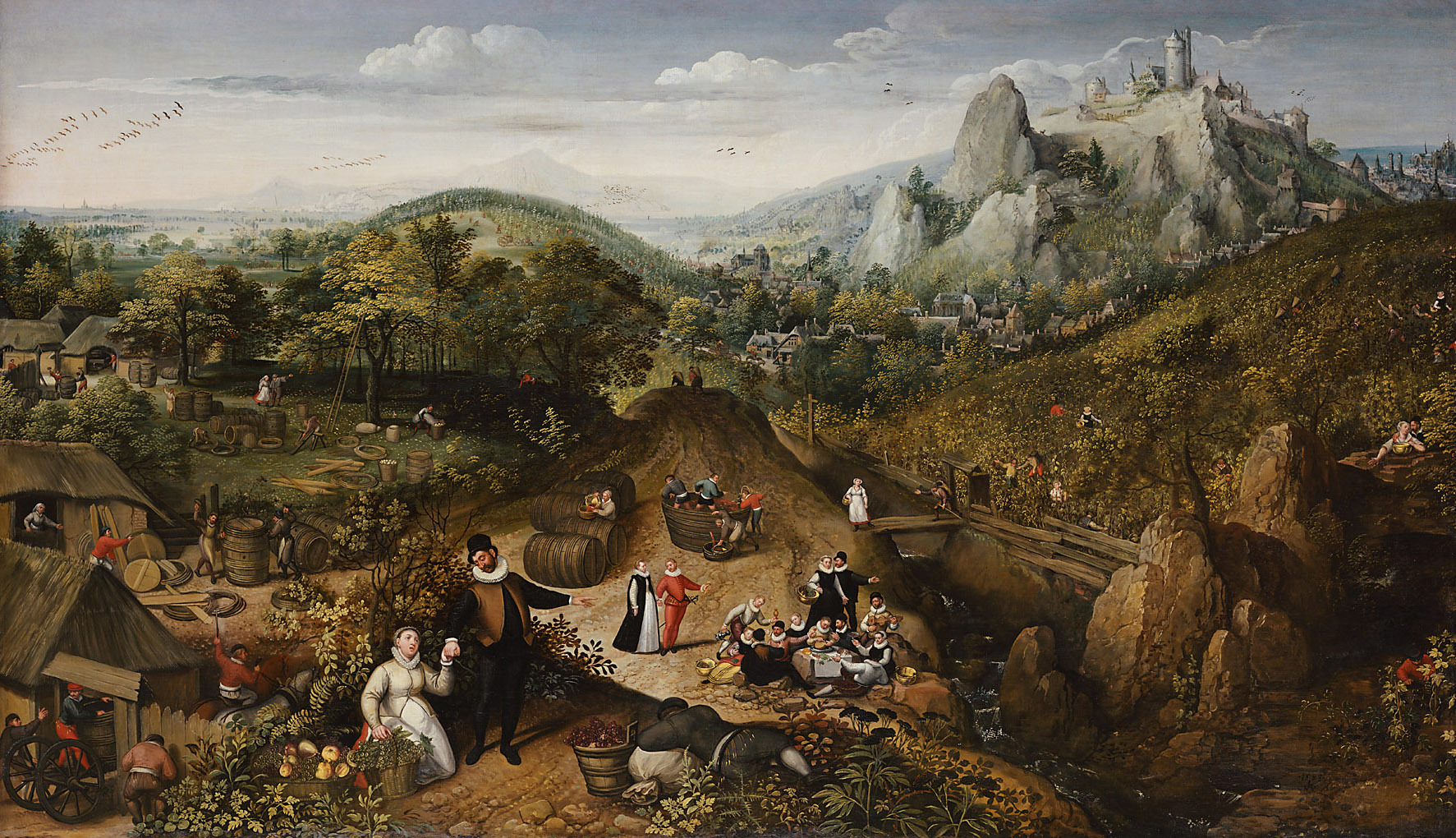
Some time in the early 2010s I was looking for furniture at a Berlin flea market when I came across a faded but striking framed reproduction of a harvest scene with stylized hills. Not that I recognized the picture, but it was clearly a Flemish landscape, a genre I’ve always liked for its tendency towards realism, ensemble casts and non-sacrality. For fifteen euros, it was a deal.

Several years later, I was half-way through a day of inspecting Habsburg loot at Vienna’s gigantic Kunsthistorisches Museum (which also cost around fifteen euros) when my partner excitedly directed my attention upwards in one of the galleries: “That’s it! Up there! That’s it!” Not faded at all, and half as big again as the reproduction, hung “Autumn Landscape (October)”, by Lucas van Valckenborch.

It’s one of at least seven seasonal landscapes painted by Valckenborch in the mid-1580s, each of them incorporating the work traditional for the month in question. It’s not clear whether Valckenborch intended to paint one for each month, or did so and the others were lost. In any case, five survivors are now in the Kunsthistorisches Museum, and a reproduction of one them can be found propped on a chest of drawers in a bedroom in the Berlin district of Wedding.

A contemporary and acquaintance of Pieter Bruegel the Elder, Valckenborch’s biography exhibits the typical elements of his profession at the time: lots of artist relatives with the same name to confuse art fans with, a patron to paint, and a peripatetic existence depending on where there was work and where he wouldn’t be persecuted as a Protestant. His fish market scenes are good as well.

Alistair Noon, March 2022

Lucas van Valckenborch, Autumn Landscape, 1585

In the distance, spot the castle
guarding its great trove of rocks;
deep within, no doubt, an arsenal,
kitchens, vaults and lots of locks.

Over that domain, a cloud
waits to salvo off its drops
onto that grey cone-roofed round
watchtower on the top-right outcrop;

by the cloud, a line of cranes
flies across and on until
every bird forgets the rain
once it finds a drier hill;

down below, men rolling barrels,
women plucking, unseen bees –
by the bucket, piles of apples;
folk in ruffs at wine and cheese.

~

Alistair Noon lives in Berlin. Paradise Takeaway, a long poem beginning and ending at Luton Airport, is forthcoming from Two Rivers Press in 2023.

Posted on Leave a comment

Poetry and Art: Ian House introduces poems inspired by Rembrandt, Rodin and Kandinsky

Poetry is often inspired by art, and poems inspire art in turn. This series of posts celebrates this special connection in the words of artists and poets who have been published by Two Rivers Press.

Sometimes I have doubts about the propriety of ekphrastic poems. The artist has done the work: selected or imagined a slice of the world, responded to it in her own way. The danger is that the poet will succumb to being a parasite who describes the work (at length, to assist the reader) before tying the ribbon with his dependent response. Over the years I have become inclined to use familiar or typical art works so that some knowledge can be assumed in readers and I can concentrate on recording the experience and feeling of standing before the work.

Ian House, March 2022

REMBRANDT

A Life

A film flows by. Watch frame-by-frame,
the illusion of a whole is gone.
Peacock, patriarch and potentate,
stricken burgher and serene artist,
each portrait reels us in, holds us fast
for thirty minutes to its truth,
a truth affirmed by the unavoidable nose,
the nose he will not gloss over, the pole
round which the masks and costumes whirl,
the rock round which the fluent selves disperse
and form the delta of his life.
Labile himself, he grips us.
Fixed, gives us the freedom to roam.

Interrogation

There’s an early painting where he pops up
as a grinning jackanapes, and in an etching
he’s a snarling, wild-haired Hamlet,
styles he’s trying out and masks he’s trying on.
By mid-career he’s looked at himself so long,
so inquiringly, so intently looking at me

that I flinch.
then face up to him,
fling the challenge back,
probe and rummage him,
and still he bears down,
demands to know,
and I turn in, go deep,
mine and defend myself.
We back-and-forth like this
till I’m barely aware who’s who
and it’s intolerable
and I tear myself from him,
diminished, enriched.

Has Been

When Rembrandt took one last look in the mirror,
he saw an old guy with uncombed grey hair,
a puffy face, that nose, dead eyes.
It seems a final honesty. All those years
had he painted not what he saw but what he saw
as what he felt he was or, more dishonest still,
what he felt he was as what he saw? At last
he closes the dressing-up box,
shows what’s there beyond apparent artifice,
a man dissolving, passing out of life.

The old master wasn’t an Old Master
but a bankrupt, sick, unvarnished failure.

No: ‘Rembrandt’ names the works and all his selves.

In Amsterdam, one January too bitter for tourists, I sat on my own for thirty minutes in a room full of Rembrandts. At Kenwood once I sat for thirty minutes facing the great late self-portrait. In life we rarely have the opportunity to look so closely and for so long at another person. Unlike a sleeper, Rembrandt (a Rembrandt self-portrait) is no passive recipient of our gaze. He meets us.

~

RODIN

Encountering Rodin

That’s no thinker but a performing of thinking,
that brazen, posturing, ponderous simulacrum,
that frozen, statuesque lump. This is a thinker,
Rodin’s first shot, a small terracotta creature
stuck on a metal rod, leaning forward,
neck straining, urgent
to see, to understand;

his hand a clenched claw,
the fingers cramped to his mouth;
his right eye a thumbed hollow,
his left eye a slit,
his back cracked and peeling
and lodged on a titanic thigh;

man or amphibian, taking life
from the fingers of his maker,
sprung from the oven of making,
still forming, gathering himself
for the first shot,
for the making,

for making the thought into thing,
the release of contortion,
the body’s projection
into thought that flows
from the head down the arm to the hand
to the nib that encounters – here, now – the page.

In July 1921 I saw The Making of Rodin at Tate Modern, an exhibition of the maquettes and plaster casts which were the first shots at the definitive marbles and bronzes with which many of the likely readers of my poems will be familiar. The quality of exploration and improvisation rejuvenated the works for me. The poem, an exploration of my feelings as I looked at one work, has, I hope, something of the same quality, reflecting the struggle of creation.

~

KANDINSKY

Things of Beauty
Kandinsky, Study for Composition VII

So lightsome and joyous this Study,
a ballet of greens and vermilions,
a profusion of Cambrian life forms,
flute solos of orange, floral starbursts of blue;
thudding browns and sunshiny yellows
are caught in the dance of the ocean,
the swirl of the springtime, urgent
as Stravinsky, sweet as Debussy:
just such a medley as I’d seen that day
in the gutter, distressful not blithe
because I couldn’t uncouple
the cylinders and circles and oblongs,
the crimsons and purples and glittering silvers
from crisps packets, sweet wrappers, coke tins.

Everything, looked at with detachment, is beautiful but that detachment is sometimes hard to achieve. Grey and rainy is as beautiful as sunny and dry but you can’t see that if you’re out in it.

~

Cover image Just a Moment by Ian HouseIan House taught in England, the United States and eastern Europe. His collections are Cutting the Quick (2005), Nothing’s Lost (2014) and Just a Moment (2021), all with Two Rivers Press. He lives in Reading.

Posted on Leave a comment

Martin Andrews Past & Present – a retrospective exhibition

March 2022: A retrospective to celebrate the 70th birthday of Martin Andrews runs in Henley from Thursday 10th until Tuesday 15th March.

The exhibition is at the Old Fire Station Gallery, 52 Market Place, Henley-on-Thames RG9 2AG, and is open daily from 11am to 4.30pm. It features paintings, prints, ceramics and sculpture representing over half a century of making. Information about the gallery is here.

Do visit if you can!

As many of you will know, Martin has been involved with Two Rivers Press for many years, contributing many illustrations and writing a few books too!

This slideshow requires JavaScript.

In 2014 the Press published Martin’s book about Fox Talbot and the Reading Establishment, which tells the story of the first British commercial photography studio.

Also in 2014 he co-authored, with Robert Gillmor, a beautifully illustrated book about the life and work of Gillmor’s grandfather the prominent wildlife artist Allen W. Seaby.

More recently, with John Froy he co-authored The Art of Peter Hay, celebrating the art and life of the founder of Two Rivers Press.

Over the years, Martin las provided many artworks and illustrations for Two Rivers Press, including the portrait of René Noyau on the cover of Earth on fire, and a wonderful painting which feature on the cover of our forthcoming short history of Reading Gaol.

His painting of the Old Dairy on Upper Redlands Road featured in The Art & History of Whiteknights, and he recorded an accompanying video, which includes a personal tour of his studio in Caversham.

Happy birthday Martin!

Posted on Leave a comment

Poetry and Art: Claire Dyer on Stanley Spencer, Ai Weiwei, and her poem ‘Of Angels, Porcelain and Paint’

Poetry is often inspired by art, and poems inspire art in turn. This series of posts celebrates this special connection in the words of artists and poets who have been published by Two Rivers Press.

~

When the call for poems was made by Two Rivers Press for their 2017 publication, Stanley Spencer Poems: An Anthology, edited by Jane Draycott, Carolyn Leder and Peter Robinson, my first stop was The Stanley Spencer Gallery in Cookham where I spent a wonderful day with Spencer’s work, making copious notes and letting the pictures imprint themselves on me.

What I particularly love about the craft of poetry is the emotional connections the imagination can make between the visual, the heard and individual memories, and when, during my research, I came across Spencer’s ‘Gardening, 1945’, which features a man and a girl, heads down, backs bent, digging up leeks, there was something about the texture of their hats, clothes and the basket the girl is holding that brought to mind Tate Modern’s 2010 installation of Ai Weiwei’s 100 million individually crafted and painted porcelain seeds. And this, in turn, instead of the actual specialists who worked in small-scale workshops in the Chinese city of Jingdezhen, took me to a roomful of angels painting the seeds.

My imagined angels were all-knowing, all-seeing, but unable to do anything to influence or change us – they were about the pure act of giving. And so, when my daughter, who had been my son, was transitioning*, I wanted for her the chance to choose her own identity and destiny without censure or judgement, and so I wrote this poem, addressed to her, about angels painting the porcelain seeds Spencer’s painting had reminded me of, and of my daughter’s right to fashion herself as many identities and destinies as she wishes, by running her fingers through the seeds, making billions of shifting pictures, all uniquely hers.

Claire Dyer, March 2022

~

Of Angels, Porcelain and Paint

Imagine a room, square windows
letting in the light. Imagine the light

is bright and yellow and falling
across rows of tables in slabs

the colour of butter. At the tables angels
are painting porcelain sunflower seeds –

the husks of sunflower seeds that is –
and, in the falling yellow light,

focus on a pigment each: pink, green,
russet, caramel, grey.

They take breaks at regular intervals,
stretch their necks and talk about the news –

somewhere a war is ending,
another about to start;

how can they survive all this?
And, on one particular, peculiar,

sun-drenched day Stanley comes,
and they give him their creations,

give him baskets brimming
with painted seeds for his collage

of two figures (daughter
and father) harvesting leeks.

He bends Kathleen to her task.
She can smell soap,

her father’s gardener’s skin
is surprisingly clean and,

if you listen carefully
you can hear a torrent of birdsong;

clouds are holding in the rain.
Imagine then you are walking

into the room with the square windows
and the light that’s bright and yellow

and falling, and Stanley says,
You can stir your fingers through the seeds

if you like, make billions of shifting pictures,
all uniquely yours.

~

From Yield, Two Rivers Press, 2021

A version of this poem appears in Stanley Spencer Poems: An Anthology, eds Jane Draycott, Carolyn Leder, Peter Robinson, Two Rivers Press, 2017

*I have my daughter’s permission to refer to her by her old name, status and gender where appropriate.